
Cardiovascular Cartography
- Home
- Cardiovascular Cartography (CCG) Test in Pune

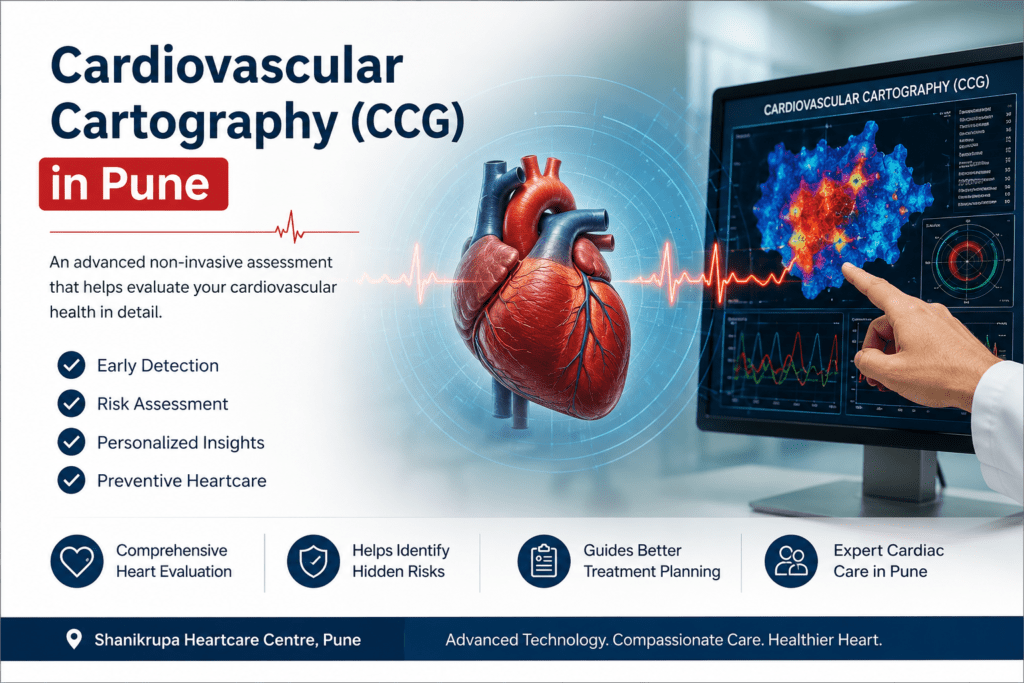
Cardiovascular Cartography (CCG) is a non invasive cardiovascular assessment designed to provide information about heart function, blood-flow patterns, and other circulation-related parameters. It can help healthcare professionals gain additional information about cardiovascular health and decide whether further evaluation may be appropriate.
At Shanikrupa Heartcare, cardiovascular cartography is used as part of a broader preventive heart-health assessment. The assessment is designed to be comfortable and non-invasive and does not require surgical procedures or hospital admission.
Early evaluation can be useful for people who have cardiovascular risk factors, symptoms, or a family history of heart disease.
Cardiovascular cartography may be considered for people who want a more detailed assessment of their cardiovascular health.
At Shanikrupa Heartcare in Pune, the assessment may be used along with a clinical consultation to understand cardiovascular risk and determine whether additional cardiac investigations are needed.
It is important to understand that no single test can diagnose every heart condition. The appropriate investigation depends on your symptoms, medical history, risk factors, physical examination, and the advice of a qualified healthcare professional.
Cardiovascular cartography uses non-invasive sensors or electrodes to collect cardiovascular information.
During an assessment, sensors may be placed on the body to record relevant cardiovascular signals. The collected information is then analyzed by the system to generate a graphical or mapped representation of cardiovascular parameters.
The assessment may provide information related to:
The exact measurements and interpretation depend on the equipment and assessment protocol used.
A healthcare professional should interpret the results together with your symptoms, medical history, examination, and other relevant investigations.
During the procedure:
A healthcare professional may consider cardiovascular assessment for people who have one or more cardiovascular risk factors or symptoms.
This may include people who:
Having a risk factor does not necessarily mean that you have heart disease. A proper medical evaluation is important before making decisions about treatment.
Shanikrupa heartcare offers a valuable non-surgical options such as EECP treatment, chelation therapy, arterial clearance therapy, and ozone therapy for selected patients with coronary artery disease and chronic angina. By improving blood flow to the heart without surgery, EECP can help reduce symptoms, improve exercise capacity, and enhance quality of life for many individuals.
At Shanikrupa Heartcare, we are committed to delivering personalized, evidence-based care focused on prevention, early intervention, and long-term heart health. If you are experiencing symptoms of heart disease or exploring non-invasive treatment options, consult our team to determine whether heart blockage treatment without surgery is is appropriate for your condition.
Cardiovascular cartography is a non-invasive cardiovascular assessment that uses external measurements to provide information about cardiovascular function and circulation-related parameters.
It is designed as a non-invasive assessment. However, whether it is appropriate for a particular person depends on their health condition and medical history. Discuss the assessment with a qualified healthcare professional.
Not necessarily. The two assessments provide different types of information. An ECG evaluates the electrical activity of the heart, while CCG may provide additional cardiovascular information depending on the assessment system used.
No. CCG should not automatically be considered a replacement for angiography or other established diagnostic investigations when these are medically indicated.
People with cardiovascular risk factors, symptoms, or a family history of heart disease or those seeking preventive evaluation can discuss cardiovascular assessment with their healthcare professional.
A healthcare professional can determine whether an assessment is appropriate based on the individual’s age, medical history, risk factors, symptoms, and preventive-care goals.
No. Cardiovascular cartography is designed as a non-invasive assessment using external sensors or electrodes.
WhatsApp us